
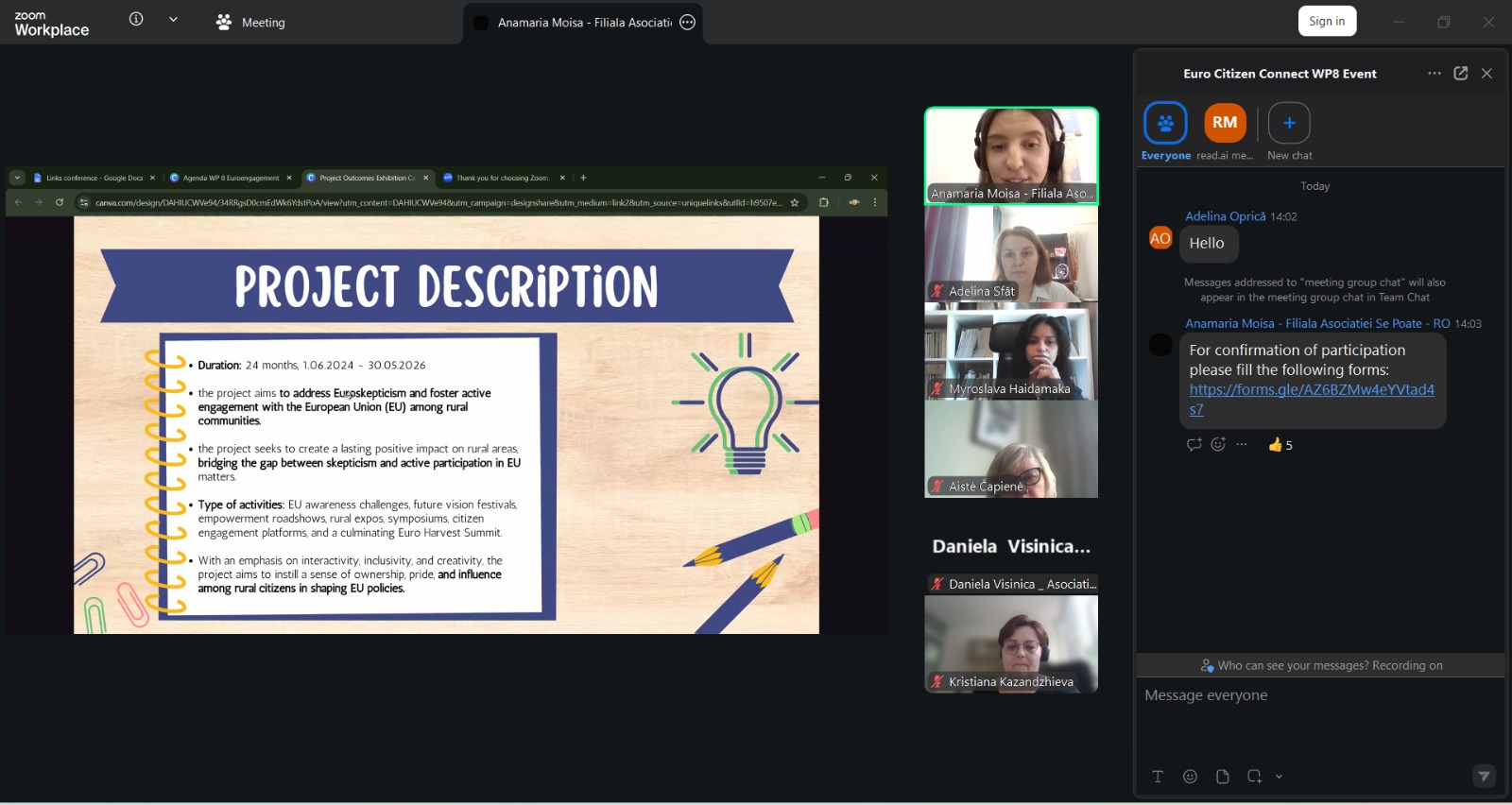
The future of Europe’s countryside took center stage at the “Euro Harvest Summit” roundtable and project finale. This high-profile virtual summit brought together 112 active participants, including project partners, stakeholders, policymakers, civic leaders, and seven premier regional and European experts.
The core mission? To celebrate the cumulative impact of grassroots rural projects, showcase successful strategies to mitigate Euroskepticism, and present actionable policy recommendations capable of bridging the gap between local communities and central European institutions.
1. The Project Outcomes Exhibition: A Digital Showcase
The summit kicked off with the Project Outcomes Exhibition, a dynamic digital retrospective honoring the dedication of cross-border European partners.
- Work Package (WP) Spotlights: Every participating partner took the floor to present the specific methodologies, breakthroughs, and localized impacts of their respective project phases.
- A Rich Media Catalog: Utilizing a customized online exhibition format, the session leveraged participant testimonials, event photography, videos, and detailed data reports.
- Standardized Tracking: To preserve these insights for future initiatives, partners utilized a comprehensive catalog template to log critical event metadata, output links, and major milestones, offering stakeholders a clear, visual grasp of the project’s widespread regional reach.
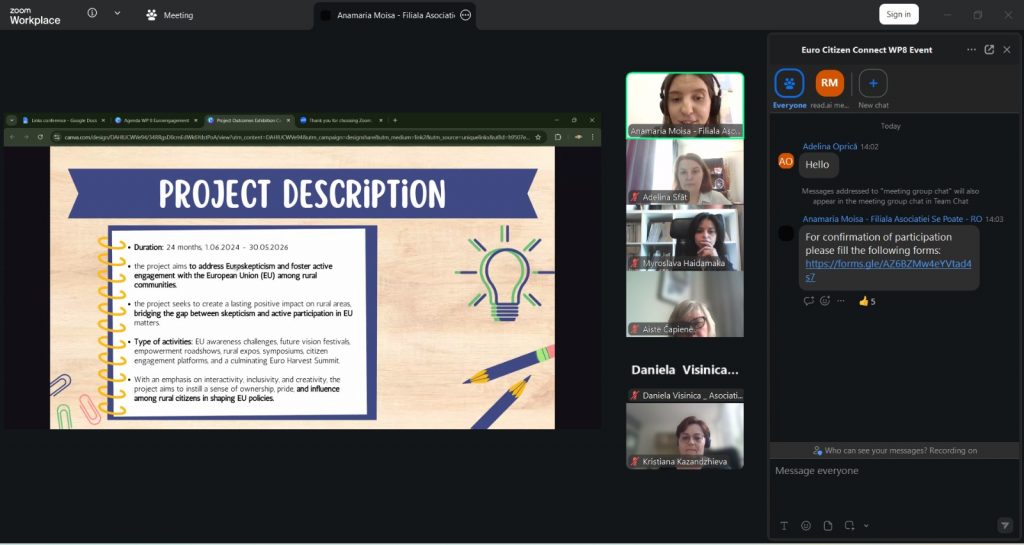
2. Unveiling the Joint Policy Declaration
Shifting gears from reflection to systemic future impact, the Filiala ASP (FASP) team led the Policy Recommendations Presentation.
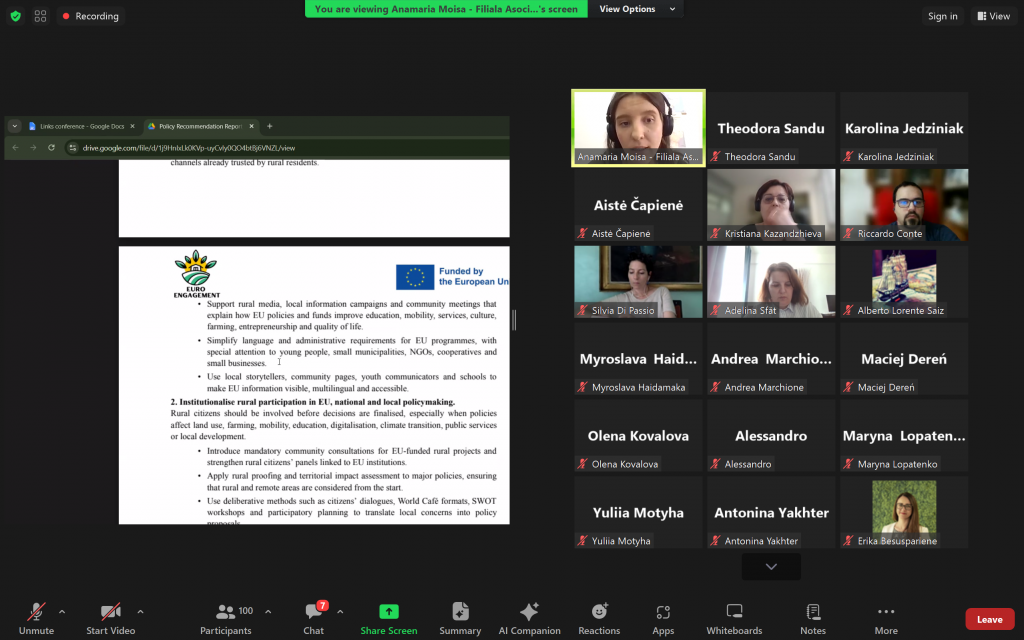
At the heart of this segment was the formal unveiling of the Joint Policy Declaration. Derived directly from extensive field consultations within rural communities, the declaration outlines pragmatic frameworks for rural development. Rather than a passive lecture, this segment functioned as a lively public forum. Invited experts and general attendees engaged in a rigorous feedback session and live Q&A to critique, refine, and expand the proposals.
The Ultimate Output: A comprehensive, finalized report featuring highly actionable policy proposals designed to directly shape future EU, national, and regional development frameworks.
3. Voices from the Field: The Expert Online Roundtable
The centerpiece of the afternoon featured a cross-sector panel of six specialists from across Europe, moderated by FASP. The roundtable navigated six highly targeted thematic segments:
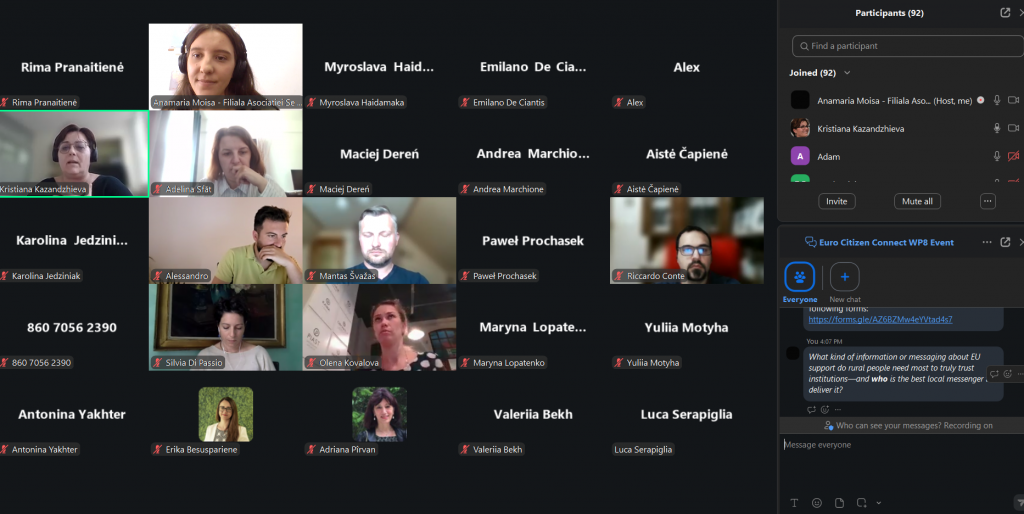
🌍 Trust & EU Engagement
- Speakers: Kristiana Kazandzhieva (Bulgaria) & Adelina Sfăt (Romania)
- Core Debate: Analyzing why rural citizens often find it harder to trust European institutions over local governments. The speakers mapped out the transparent messaging strategies and trusted local messengers required to build genuine, lasting institutional trust.
🗳️ Deepening Civic Participation
- Speakers: Adelina Sfăt (Romania), Silvia Di Passio (Italy), & Paweł Prochasek (Poland)
- Core Debate: Moving past tokenistic “checkbox” exercises. The panel explored how to structurally design rural dialogue formats so that historically silent demographics are actively heard and included before major political decisions are made.
🌱 Rural Youth Activation
- Speakers: Paweł Prochasek (Poland) & Silvia Di Passio (Italy)
- Core Debate: Crafting the physical infrastructure, local support networks, and digital tools necessary to incentivize young professionals to remain in or return to rural zones after their studies.
⚡ The Green Deal & Rural Transition
- Speaker: Mantas Švažas (Lithuania)
- Core Debate: Demystifying the European Green Deal for agricultural workers. The discussion focused on the precise financial, educational, and logistical support farmers need to adapt to ecological shifts without economic anxiety, drawing on successful national examples of localized food systems and renewable energy.
🚌 Mobility and Digital Access
- Speakers: Alberto Lorente Saiz (Spain) & Mantas Švažas (Lithuania)
- Core Debate: Tackling the compounding isolation of aging populations and youth caused by limited public transit. The experts outlined why robust infrastructure investments and bridging the digital connectivity gap remain absolute prerequisites for regional equity.
🎭 Local Identity and Cultural Heritage
- Speakers: Alberto Lorente Saiz (Spain) & Kristiana Kazandzhieva (Bulgaria)
- Core Debate: Leveraging regional food, traditional crafts, and local history as modern economic drivers. The segment highlighted how cultural pride helps younger generations feel rooted in their homes while simultaneously feeling integrated into the broader European identity.
Following the panel, audience engagement spiked during an interactive Q&A utilizing Wooclap software to capture real-time feedback and crowdsource questions.
4. Collaborative Networking: Planting Seeds for the Future
The finale concluded not with goodbyes, but with a highly structured, forward-looking Networking Session.
Using interactive Mentimeter polling, organizers collected real-time audience data to construct word clouds and diagrams mapping out the most pressing community needs and systemic bottlenecks. Armed with these insights, participants entered an open dialogue to sketch out future cross-border consortiums and funding bids.
To ensure long-term, direct European cooperation, all attending organizations logged their capabilities, specialized interests, and contact information into a centralized partnership database, distributed to all 112 participants immediately following adjournment.
📂 Access the Official Event Resources
The official documentation, comprehensive reports, and project outputs from the summit are fully accessible to the public.
Interested stakeholders, policymakers, and citizens can review the Event Description Sheet, Project Outcomes Exhibition Catalog, the Policy Recommendations Report, and the Expert Online Roundtable Summary Report here:

Funded by the European Union. Views and opinions expressed are however those of the author(s) only and do not necessarily reflect those of the European Union or the granting authority. Neither the European Union nor the granting authority can be held responsible for them.